VOCs Exhaust Treatment
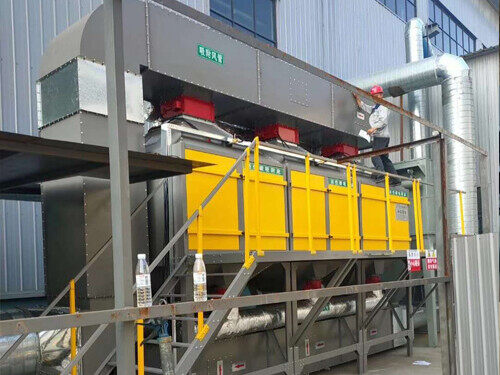
Coating Line VOCs Treatment with RTO and Scrubber
Three chamber RTO with upstream spray scrubber for a metal coating line, recovering heat back to the curing oven to cut fuel consumption.

Chemical & Coking
Coking flue gas treatment, tar capture, VOCs recovery and corrosion-resistant dust collection.
Working condition
Recommended configuration
Each row shows the process stage, the machine we normally select and the point that decides whether it performs on site.
| Process stage | Recommended equipment | Selection point |
|---|---|---|
| Tar and heavy fraction capture | Wet electrostatic precipitatorGP-CDPK / GP-WESP Series | Conductive FRP or 316L construction for acid mist and tar aerosol. |
| Acid and alkali gas washing | PP or FRP spray scrubber towerGP-PP / GP-FRP Series | Material selected per chemical and temperature, pH dosing with conductivity control. |
| Organic exhaust oxidation | RTO or catalytic combustion unitGP-RTO-2 / GP-RTO-3 Chamber | Halogen and sulphur containing gas needs downstream scrubbing after oxidation. |
| Low concentration odour | Activated carbon adsorption unitGP-AC Series | Pre-filter upstream, differential pressure monitoring for replacement timing. |
| Odour polishing | UV photocatalytic odour purifierGP-UV Series | Used downstream of scrubbing or adsorption for residual low concentration odour; pre-filter required where mist is present. |
| Flue gas from process heaters | FGD and SCR systemGP-ULE Series | Compact layout for constrained plots, bypass damper for maintenance. |
Energy
Chemical plant exhaust standards and explosion protection classification are defined by national and site regulation. Equipment selection must follow the hazard area classification of the installation point.
Related projects

VOCs Exhaust Treatment
Three chamber RTO with upstream spray scrubber for a metal coating line, recovering heat back to the curing oven to cut fuel consumption.
Technical reading

A decision path from low concentration high volume to high concentration low volume, covering adsorption, oxidation, scrubbing and combination schemes.

Operating temperature, concentration window, catalyst poisoning risk, fuel use and safety interlocks compared for RTO and catalytic combustion units.

Wet, semi-dry and dry FGD compared with SCR and SNCR denitrification, including temperature window, reagent use, by-products and retrofit constraints.
Send air volume, dust or gas data, temperature and available space. Our engineers reply with a configuration proposal and a budget quotation within 1 working day.
Kami hanya menggunakan cookie esensial agar situs ini berfungsi dan untuk mengingat bahasa serta pilihan persetujuan Anda. Tidak ada cookie iklan atau pelacakan lintas situs yang digunakan. Baca Kebijakan Privasi.